Key takeaways
- A foreign buyer can complete a purchase in José Ignacio without Uruguayan residency, using only a passport, criminal record certificate, and proof of fund origin.
- Remote buyers increasingly replace first-wave showings with measurable floor plans, sun-path orientation, and occupied-property virtual walkthroughs.
- Listings that let buyers verify details remotely draw international offers without a single in-person showing while comparable properties sit.
Contents
The Buyer Who Boards the Plane Last
A German buyer can complete a purchase in José Ignacio without ever obtaining residency in Uruguay. A passport, a criminal record certificate, and proof of the origin of funds are enough. What looks like a legal detail is actually the starting point for how Uruguay's coastal market now receives foreign demand.
Remote buyers do not wait until they land to form an opinion. They measure rooms, check orientation, and discard properties from another time zone. A broker who serves that sequence gets a buyer who is already past the first three eliminations. The broker who does not never hears the call.
What a Remote Buyer Actually Needs Before Committing
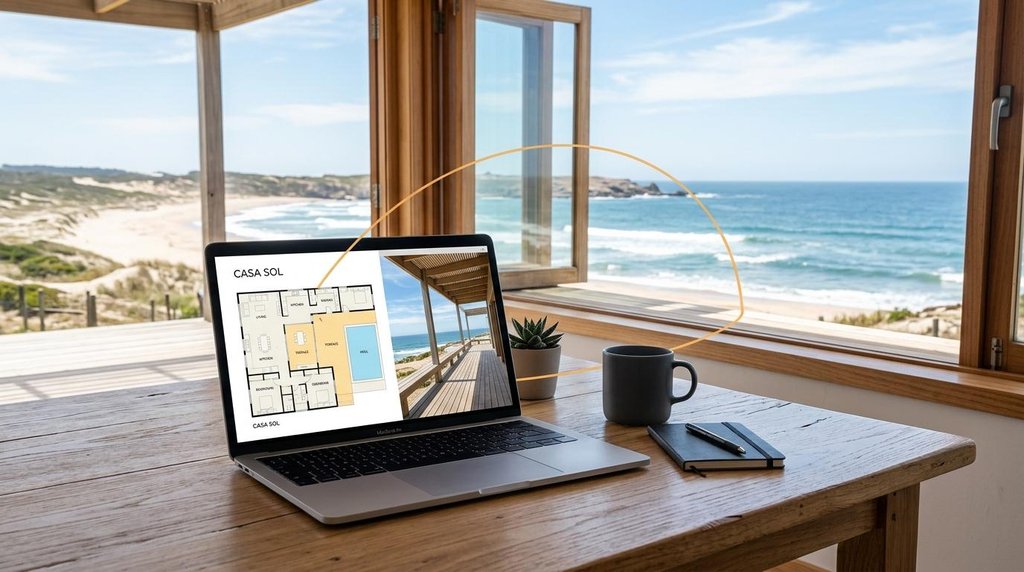
Remote buyers are not asking for better marketing. They are asking for a complete sense of place. A floor plan with real dimensions, a walkthrough that works while the property is still occupied, and a clear view of how light moves through the main room in the afternoon.
Those elements replace the first wave of in-person showings that would normally consume a broker's week. A buyer who can verify layout and orientation from abroad reaches the first conversation already shortlisting, not browsing.
- Measurable layout: 2D and 3D floor plans with real m², not wide-angle guesses.
- Orientation and light: a sun-path view that shows whether the terrace gets morning or afternoon sun.
- Occupied-property access: a virtual walkthrough that does not require emptying the house first.
- Vetted inventory: a property that is genuinely for sale at a current price and backed by a listing agreement.
In practice, a broker who can produce that complete virtual product at production cost has an advantage with buyers who preview before they travel. It is not the gear that matters; it is the predictability the buyer feels before sending a message.
Foreign Demand Has Geography, Not Just Volume
Argentine buyers remain the largest foreign group, concentrated in Punta del Este, Maldonado, Colonia, and Carrasco. Brazilian demand has grown steadily in Punta del Este, José Ignacio, and Cabo Polonio. Buyers from the United States and Europe tend to be retirees or high-net-worth investors in Carrasco, Pocitos, and Punta Carretas.
Chilean, Peruvian, and Paraguayan buyers form a smaller but established presence. That map is useful, but it tells a broker where demand comes from, not how it behaves.
The more meaningful split is between buyers who visit first and buyers who commit after remote verification. A Chilean buyer in Santiago and a German buyer in Munich may share more habits with each other than with a Buenos Aires buyer who crosses the river for a weekend.
That is why some coastal listings draw international offers without a single in-person showing while comparable properties sit. The difference is rarely the house itself. It is whether the remote buyer could verify what the broker described.
A caveat belongs here. Most detailed nationality claims in Uruguay come from brokerage blogs, not a centralized buyer registry. Treat the geography as a working impression, not a fixed index. What repeats across cycles is the behavior underneath it.
The Distant Buyer Rewards the Broker Who Curates
Uruguay's purchase market is moving toward a simple test: can a foreign buyer confirm a property before buying the plane ticket? Brokers who pass that test spend less time on dead showings and more time on buyers who arrive ready to negotiate.
That shift does not make brokers less relevant. It makes their curation more valuable. A buyer in Hamburg or Austin is not replacing judgment with a video; they are using the video to decide which broker is worth calling.
In a market without a central MLS, remote clarity carries extra weight. It is the closest thing a buyer gets to walking through the door before leaving home.
Domizello understands that remote demand changes the order of the sale, not the need for a broker. Brokers who want to work that way can explore the para-agentes program.
Frequently Asked Questions
Do I need to become a resident of Uruguay to buy property there?
No. A foreign buyer can complete a purchase without obtaining residency in Uruguay, using a passport, a criminal record certificate, and proof of the origin of funds.
What documents are required for a foreigner to buy real estate in Uruguay?
The core documents are a passport, a criminal record certificate, and proof of the origin of funds. For remote buyers, a listing agreement backing the property is part of vetted inventory.
Which foreign buyers are most active in the Uruguayan real estate market?
Argentine buyers are the largest group, concentrated in Punta del Este, Maldonado, Colonia, and Carrasco. Brazilian demand is growing in Punta del Este, José Ignacio, and Cabo Polonio. U.S. and European buyers tend to be retirees or high-net-worth investors in Carrasco, Pocitos, and Punta Carretas. Chilean, Peruvian, and Paraguayan buyers form a smaller but established presence.
What do remote buyers need before committing to a property in Uruguay?
Remote buyers need a complete sense of place before they travel: floor plans with real m², sun-path orientation showing morning or afternoon light, virtual walkthroughs that work even while the property is occupied, and vetted inventory at a current price.
Why do some coastal listings in Uruguay sell without a single in-person showing?
Because the buyer could verify layout, orientation, and condition from abroad. The difference is rarely the house itself; it is whether the remote buyer could confirm what the broker described before buying a plane ticket.