Key takeaways
- Casapueblo's 36-year, blueprint-free build on Punta Ballena set a place-rooted standard that current prime listings fail to match, reducing stone floors, lapacho terraces, and ocean-framing galleries to amenity bullet points.
- Named-architect homes – from a Bóxer Anaya Golf house in the early 1980s to Martín Gómez's San Vicente oceanfront project using local stone and hewn wood – are marketed as feature checklists, erasing the design logic that makes them valuable.
- Uruguay's portal-driven market without a central MLS rewards volume and filters over character, but complete visual production (3D tours, floor plans, sun-path viewers, fly-through video) lets the property do first filtering, shifting advantage to curating brokers.
Contents
Casapueblo set the bar – the listing market has not caught up
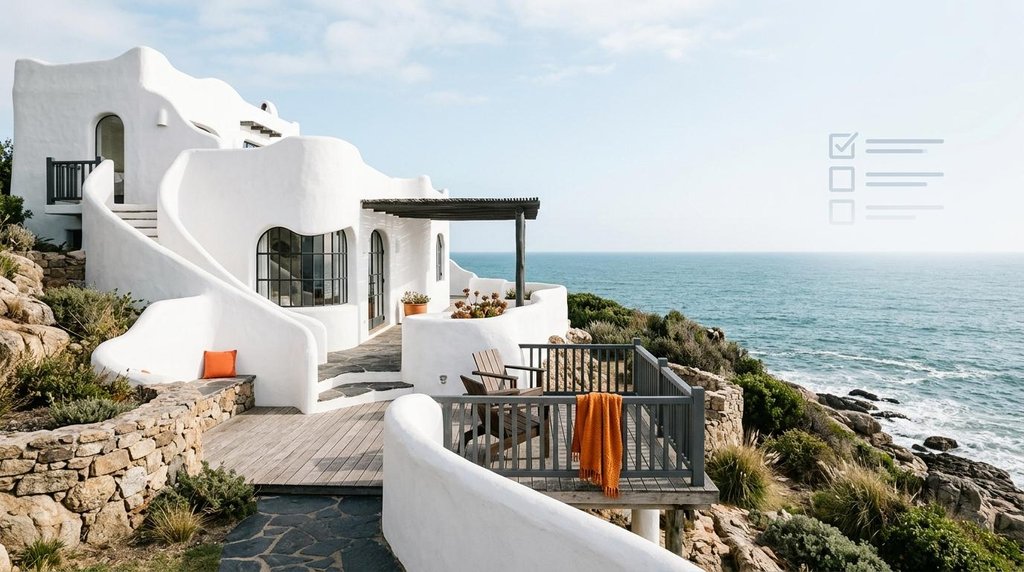
Casapueblo took 36 years to build, without a blueprint, on a cliff above Punta Ballena. Its whitewashed curves, shaped with help from local fishermen and inspired by the hornero's nest, still hold one of Uruguay's clearest lessons about residential character: place-rooted architecture ages differently.
Thirteen sculpted stories of whitewashed cement and stucco rise without a single straight line, an approach often compared to Santorini but rooted in Punta Ballena's Atlantic light and wind.
Uruguay's prime market has never been short on authentic material. Local stone, lapacho wood, and Atlantic-facing galleries appear up and down the coast. What has lagged is the way those properties are shown.
When a comparable home in Maldonado gets listed, the character often disappears into amenity language. Stone floors, lapacho terraces, and a gallery that frames the ocean become bullet points rather than reasons to visit.
That gap matters for brokers. In a market that runs without a central MLS, the person who can make a home's character legible before a buyer ever steps inside controls which listings get remembered.
Why distinctive character gets reduced to an amenity checklist
High-end Maldonado listings regularly show more character in the property than in the copy. A José Ignacio home near Laguna Escondida may be described with stone floors, large galleries, and an exterior of lapacho and rustic travertine on a 1,700 m² lot. A La Barra penthouse duplex gets summarized by its 350 m² interior, nearly 500 m² total, and a private heated pool.
Both descriptions are accurate but thin. The materials and the spatial logic are mentioned, then immediately buried under a checklist of finishes and features. A buyer scrolling a portal sees a standard apartment, not a coastal house with its own physical logic.
That pattern continues even when a named architect is attached. A Golf house by Bóxer Anaya from the early 1980s, or a San Vicente oceanfront project by Martín Gómez built with stone and hewn wood from the surrounding area, rarely gets an explanation of why those choices matter. The portal treats distinctive architecture as another filter, not a story.
The result is a market where genuinely special homes are often marketed the same way as standard inventory. The property has more personality than its listing, and that asymmetry quietly works against both the seller and the broker.
When lapacho and stone are allowed to carry the story
Professional production changes what a listing can do. A 3D tour lets a buyer move through a U-shaped San Vicente house before knowing the lot size. A fly-through video shows how afternoon light crosses a stone wall. Floor plans reveal a gallery that wraps the house, something no adjective can make clearer.
That kind of digital product matters more in Uruguay because many buyers are evaluating from outside the country or well before a showing is practical. The property has to do the first filtering. When the visuals and plans are complete, only buyers who already feel the character tend to request a visit.
A complete virtual product also solves a practical brokerage problem: it lets a property be previewed even while it is occupied. Instead of spending showings on the wrong buyers, a broker can hand over a walkthrough and let the house eliminate the mismatches.
Domizello applies that logic at listing level. Every property appears once, with an interactive 3D tour, 2D and 3D floor plans, a sun-path viewer, professional photos, and fly-through video, produced at production cost rather than through expensive agency retainers. The broker who actually curates the property is the one who earns the buyer's attention.
The tension between volume and curation
There is a tension here. Listings in Uruguay have become better at speed and worse at patience. A drone shot is easy; a narrative built around why a Bóxer Anaya house matters is rare. The portals reward completeness and fast publishing, which pushes brokers toward inventory volume instead of character.
Portals are built for filters: price, bedrooms, square meters, location. Character does not fit a filter, so it gets pushed to the bottom of the description.
That is the opposite of what the best local examples teach. Casapueblo, as documented by ArchDaily, was not built to be listed quickly. It accumulated meaning over decades. A home does not need 36 years of construction, but it does need a broker who can explain the decisions embedded in its materials and form.
Without a central MLS, this tension gets sharper. Duplicate listings, stale prices, and photos that do not match reality are common side effects. A beautifully produced tour means little if the property is no longer genuinely for sale at the price shown.
For buyers, this is why current, verified listings matter. Add complete virtual production and the search becomes less noisy, not more.
Uruguay's next standard is visual, not verbal
Uruguay's prime market does not lack special homes. It lacks a consistent way to show them as they are. The shift will not come from more adjectives in listing descriptions; it will come from production that lets a coastal house speak through its lapacho, its stone, and its orientation to the sun.
That is the direction the market is heading. Brokers who treat a distinctive property as an asset to be staged digitally, not just described, will be the ones who hold buyer attention in a noisy, portal-driven search.
Brokers who want that standard have a practical next step through domizello's broker program.
Frequently Asked Questions
Why does Casapueblo matter for Uruguay's real estate market?
Casapueblo in Punta Ballena shows that place-rooted, character-driven architecture ages differently and holds lasting value. Its 36-year, blueprint-free construction with local materials and organic forms set a standard that most current prime listings in Uruguay have not matched in presentation.
How do typical luxury listings in Maldonado undersell distinctive homes?
They reduce unique features like lapacho wood, local stone, and ocean-facing galleries to amenity checklists. This strips away spatial logic and architectural story, leaving buyers to see a standard property instead of a coastal house with its own physical identity.
Why are 3D tours and virtual production important when buying property in Uruguay?
Many buyers evaluate from abroad or before in-person showings. A complete virtual product with 3D tours, floor plans, fly-through video, and sun-path views lets a property self-filter and communicate character before a visit, reducing wasted showings.
How does the absence of a central MLS affect luxury real estate in Uruguay?
Without a central MLS, duplicate listings, stale prices, and mismatched photos are common. Buyers must rely on current, verified listings, and complete virtual production becomes even more important to reduce noise and confirm what is actually for sale.
What should brokers do to market architecturally distinctive homes in Uruguay?
Brokers should move beyond adjectives and use professional digital production such as interactive 3D tours, accurate floor plans, sun-path viewers, and fly-through videos. Domizello offers this at production cost through its broker program, helping curated listings earn buyer attention.