Key takeaways
Landlords have 72 business hours after lease end to file a formal damage claim with ANDA, making a move-in record essential.
ANDA's standard inventory format enables room-by-room condition recording, and digital captures provide dated visual evidence.
Rental guarantee insurance can replace cash deposits, but insurers still require a coherent evidence file, which a digital inventory provides.
Contents
Seventy-two hours to avoid a deposit fight
Seventy-two business hours. That is how long a landlord has, after the lease ends, to file a formal damage claim through ANDA with the keys in hand and a list of detected defects. Most deposit arguments start long before that clock matters because there is no clear record of how the home looked on day one.
For furnished apartments, the standard is plain: the contract should include a detailed inventory of the condition of each element, from the kitchen front to the sofa arm. In daily practice, many leases still run for two years on a few phone photos and an optimistic handshake.
The result is not always bad faith. It is two people remembering the same apartment differently. One sees a pre-existing scratch; the other sees a fresh mark. That gap is where deposits turn into arguments.
The room-by-room standard Uruguay already has
Uruguay's rental guarantee system already anticipates this problem. ANDA's standard inventory format allows a managing agency to record the condition of a property without waiting for an external inspection. The form is available in the same public document library as the claim models, which tells you how routine the step is meant to be.
A workable inventory is not a paragraph that says 'good condition'. It is a room-by-room account. Walls, floors, doors, kitchen fronts, appliances, mattresses, curtains, terraces. Each surface gets a condition note, and photographs or digital captures are dated to fix them at a moment.
The detail matters because the post-lease process is formal. The landlord has to present the detected damage together with the property key at an ANDA branch. An inspector then verifies the claim and calculates compensation according to a damage table, not according to the landlord's sense of grievance.
The rules also set a ceiling for private settlements. Landlord and tenant can agree directly on compensation only when the damage does not exceed 3,000 Unidades Indexadas. Above that figure, the claim moves into the inspection circuit. In both cases, the first question is the same: was this damage already there at move-in?
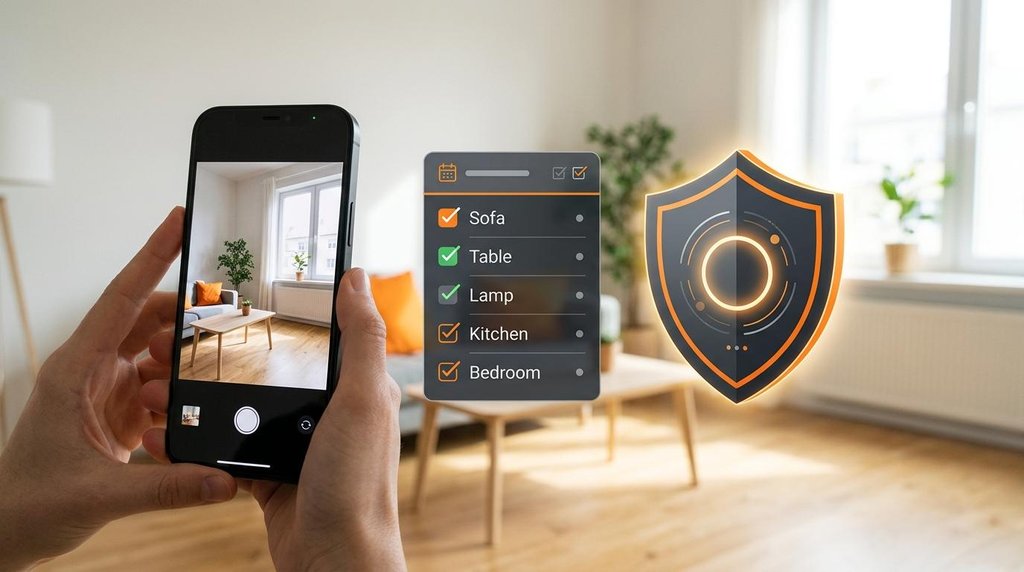
A dated visual record changes that negotiation. A digital pass through the unit, made when the listing is prepared, shows the exact state of each room at a fixed date. It is not a paper list; it shows the mark on the wall, the scratch on the glass cooktop, the condition of the sofa arm. When the tenancy ends, the comparison is between two images, not two memories.
When a guarantee replaces the deposit
Any serious discussion of deposits in Uruguay has to acknowledge the counter-model. Rental guarantee insurance can eliminate the cash deposit altogether, covering damage up to three times the monthly rent, plus defined shares of unpaid common expenses and utilities for limited periods. For some landlords, that route is preferable to holding cash and defending it later.
But the guarantee does not remove the need for an inventory; it changes the audience. The insurer's inspector becomes the person comparing the claimed damage against the policy's own damage table. And under the guarantee system, the claim window and procedure stay formal, so the landlord's file has to be coherent enough to survive an external review.
The unspoken tension in the market is that the smaller the landlord, the thinner the file tends to be. Agencies may use standard formats; individual owners often rely on whatever they happened to photograph. Yet the formal system assumes evidence, not memory. That is the practical gap a digital inventory can close.
On domizello, the first marketing pass becomes an evidentiary record. The same room-by-room capture that shows the apartment to a prospective tenant can remain alongside the rental listing as a dated record of condition. The deposit stays the tenant's money; domizello does not hold it. What the record does is shrink the argument about whether a burn mark on the counter was already there.
The rental file that outlives the lease
The rental market's real maturation is not about collecting a larger deposit; it is about keeping better evidence. A furnished unit changes hands twice, at move-in and move-out, and the condition of every surface matters. Landlords who treat the listing as the start of the lease file, not just a shopping window, have fewer unknowns later.
If you are preparing to rent out a property, the practical step is to build that record before the first tenant arrives. Speaking with an agent who works with a complete rental file can set the standard for the entire lease, from the first inquiry to the final inspection.
Sources
ANDA: Official FAQ covering inventory formats, the 72-business-hour damage claim window, and the 3,000 UI private settlement ceiling.
Frequently Asked Questions
How long does a landlord have to claim damages after a lease ends in Uruguay?
A landlord has 72 business hours after the lease ends to file a formal damage claim through ANDA, presenting the property keys and a list of detected defects.
What should a furnished apartment inventory include in Uruguay?
A furnished apartment inventory should be a room-by-room account covering walls, floors, doors, kitchen fronts, appliances, mattresses, curtains, and terraces, with each surface given a condition note and dated photographs or digital captures.
Can a rental guarantee replace a cash deposit in Uruguay?
Yes, rental guarantee insurance can eliminate the cash deposit, covering damage up to three times the monthly rent plus defined shares of unpaid common expenses and utilities for limited periods.
What is the maximum amount for a private damage settlement between landlord and tenant in Uruguay?
Landlord and tenant can agree directly on compensation only when the damage does not exceed 3,000 Unidades Indexadas. Above that figure, the claim moves into the inspection circuit.
Why is a dated visual record important for rental deposits in Uruguay?
A dated visual record, such as a digital pass through the unit made when the listing is prepared, shows the exact state of each room at a fixed date, allowing comparison between two images rather than two memories when the tenancy ends.