Key takeaways
- Occupancy hits 90% between Dec 20 and Jan 15, but the market has three distinct phases, not one continuous season.
- Virtual tours eliminate the conflict between rental income and showings, keeping listings visible even when occupied.
- Approved construction of 5.92 million m² (2015-2025) signals a shift toward year-round residency, but demand remains seasonal.
Contents
Uruguay's Coastal Market Moves on Two Calendars
Uruguay's coastal property market does not run on a twelve-month calendar.
The administrative year moves from January to December. The sales year moves from roughly mid-December to March, and inside that stretch sits an even narrower peak. Figures attributed to the Cámara Inmobiliaria put occupancy in the Punta del Este area at around 90% between December 20 and January 15. The precise geographic scope deserves some caution, but the pattern is familiar to any broker who has worked the coast.
That compressed window shapes when listings go up, when buyers actually arrive, and how negotiation plays out. Brokers who wait until January to prepare are already reacting instead of positioning.
A 90% Window Inside the High Season
What looks like a four-month season on paper behaves more like three distinct moments. The first is the Christmas-to-mid-January compression, when occupancy reaches its highest point and the market feels busiest. The second is the rest of January through early March, when the coast remains active but the urgency softens. The third begins when the season ends and the property quietly returns to the reality of local demand.
That structure changes listing strategy. A property prepared in November can capture the earliest wave of attention. One that goes live after the January peak arrives into a market where the same buyers have already seen the most visible options. Timing is not superstition; it is about being present before the decision window narrows.
Tourist rental data shows the same unevenness. Demand concentrates on high season and long weekends, then falls sharply midweek and outside the season. Brokers who measure activity by January weekends alone can overestimate how many serious buyers are actually in town on a Tuesday in February.
There is a second pressure at work. The most desirable weeks for attracting attention are also the weeks when a property may be occupied by tenants or seasonal renters. A seller who avoids that conflict takes the listing offline during precisely the months when buyer energy peaks. A seller who insists on physical showings risks friction with the very occupancy that makes the asset attractive.
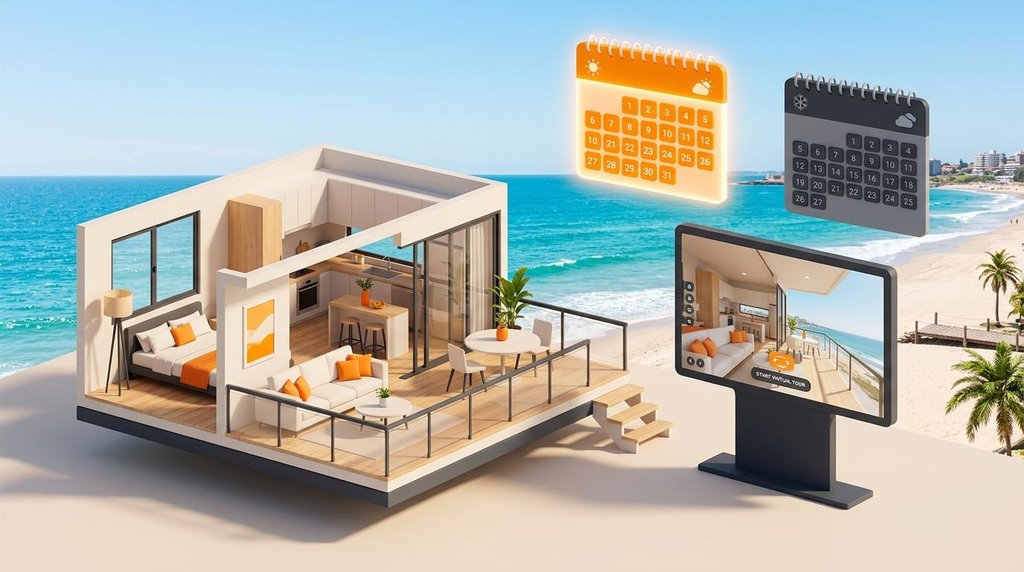
Virtual touring removes that trade-off. An interactive 3D tour, with two-dimensional and three-dimensional floor plans, a sun-path viewer, professional photos, fly-through video, and a digital inventory alongside it, allows a buyer to inspect flow, light, and finish without crossing the threshold.
Domizello carries that complete virtual product on every listing. The practical effect is that marketing does not have to pause when the keys are not available. A broker can keep a property in front of buyers while it is generating income, and only take the buyer to the property when the interest is already real.
When the High Season Becomes Its Own Weakness
There is a counter-narrative worth taking seriously. The same high season that feeds the coastal market is also its structural weakness.
The push to make Maldonado a year-round economy is real, but it is not finished. A coastal development plan projects 8,200 visitor rounds in a year, with only 2,100 of them falling between April and November. That is a developer projection, not a market result, and it illustrates how much activity still sits inside the southern summer.
Approved construction tells a similar story. Local government figures put roughly 5.92 million m² of approved construction in the department between 2015 and 2025, much of it linked to consolidation as a year-round residence. More permanent stock changes the market's floor, but it does not automatically spread buyer demand across the calendar.
Argentina remains the wild card. Demand has repeatedly cooled when the Argentine economy weakens and reactivated when it stabilizes. A strong January in Punta del Este can still stall in February if the buyers across the river suddenly postpone decisions.
That is the central tension: the same high season that creates urgency also leaves a long tail. After the January peak, unsold inventory begins to look older than it actually is. Buyers return with more patience, and the negotiation dynamic shifts. Brokers who understand this do not chase the season; they use it to create a deadline that works for sellers without pretending the deadline lasts forever.
A Listing Never Has to Go Dark
The market is not becoming seasonless. Anyone who claims otherwise is selling a future that has not arrived. What is changing is how a property behaves inside and around the season.
A buyer no longer needs an empty property to form an opinion. A listing no longer needs to disappear when the occupants hold the keys. A broker no longer needs to spend January showing properties to people who were never serious.
That is a meaningful shift for Uruguay's coastal market because it lowers the cost of staying active. The seasonal window remains the main event, but the window for decision-making extends beyond it.
Domizello's platform is built around that reality: a property can stay visible, documented, and preview-ready through the high season and beyond. Brokers who want to work the calendar rather than fight it can look into the broker program.
Frequently Asked Questions
When is the best time to list a coastal property in Uruguay?
The best time to prepare and list is November, before the December 20 to January 15 peak. That peak shows around 90% occupancy in the Punta del Este area, so a listing live before it captures the earliest wave of buyer attention instead of arriving after buyers have already seen the most visible options.
What is the highest-demand period for Punta del Este real estate?
According to figures attributed to the Cámara Inmobiliaria, occupancy in the Punta del Este area reaches roughly 90% between December 20 and January 15. This compressed window is the busiest moment of the coastal sales year, even though the broader high season runs from mid-December to March.
How can a broker sell a property that is occupied by seasonal renters during the high season?
Virtual touring removes the trade-off between rental income and marketing. A complete digital package with 3D tours, floor plans, photos, video, sun-path viewer, and inventory lets buyers inspect the property without entering it. With domizello, the listing does not have to go dark when the keys are not available.
Does Uruguay's coastal property market work year-round?
Not yet. The high season dominates, and off-season activity is much lower. A coastal development projection shows only 2,100 of 8,200 annual visitor rounds falling between April and November. Argentina's economy also drives demand, so a strong January can stall if Argentine buyers postpone decisions. Using domizello's digital package helps brokers keep properties visible beyond the peak, but the market remains seasonal.
How does the end of the high season affect negotiation?
After the January peak, unsold inventory starts to look older, and buyers return with more patience. The negotiation dynamic shifts in their favor. Brokers who understand this use the high season to create urgency without pretending the deadline lasts forever.